













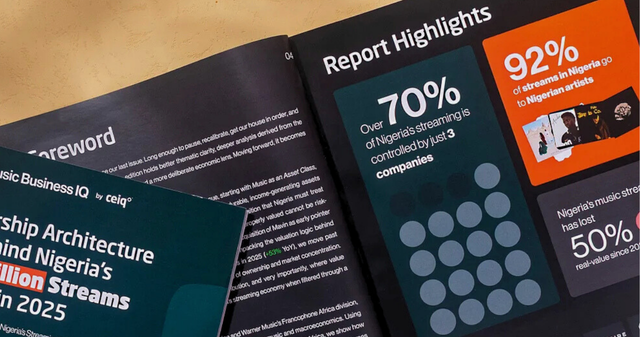
Creator Economy IQ music industry report examining Nigeria and South Africa’s streaming markets has found that local content dominates consumption, but control of value concentrates among a small number of global players at the upstream level.
The report, the second issue from the research outlet, analysed thousands of songs and billions of streams across Spotify and Apple Music in both territories. It represents 19 months of work following the publication’s first issue in July 2024.
Across approximately 1,000 of the most streamed songs on Spotify in Nigeria, totalling more than 3.77 billion streams in 2025, 92 percent of those streams went to Nigerian releases. The remaining share was distributed across artists from just 12 other countries.
South Africa showed similar patterns. Local artists captured 76 percent of the country’s 1.8 billion streams in 2025, with the remaining share spread across artists from only 10 other markets. The report includes breakdowns of releases from these secondary markets across both regions.
The research introduces a three layer analytical framework designed to reflect the actual structure of the music business value chain. Unlike the previous issue where all players were analysed at the same level, the new approach distinguishes between primary labels and imprints where content originates, distribution companies that route content to streaming platforms, and parent entities that ultimately consolidate value at the top.
Primary labels and imprints include companies like Mavin, YBNL, and Dvpper where musical content is first owned. Distribution companies such as ONErpm, Virgin, and EMPIRE control access and rights along the delivery chain. Parent entities including Universal Music Group, Sony Music, and EMPIRE represent the multinational companies that consolidate value.
The report found that while Nigeria’s music ecosystem appears fragmented at the downstream level among many primary labels and imprints, it shrinks considerably moving upstream. Just three companies control approximately 75 percent of Nigeria’s streaming market across major DSPs at the parent entity level.
It examines streaming subscription economics across Nigeria, South Africa, and Kenya, tracing how macroeconomic forces shape the music industry from household budgets to rights holder revenue. It includes a real life payout scenario to illustrate these dynamics.
The full report is available in both print and digital formats. The digital version is available as a read online edition and downloadable PDF, see report here.