














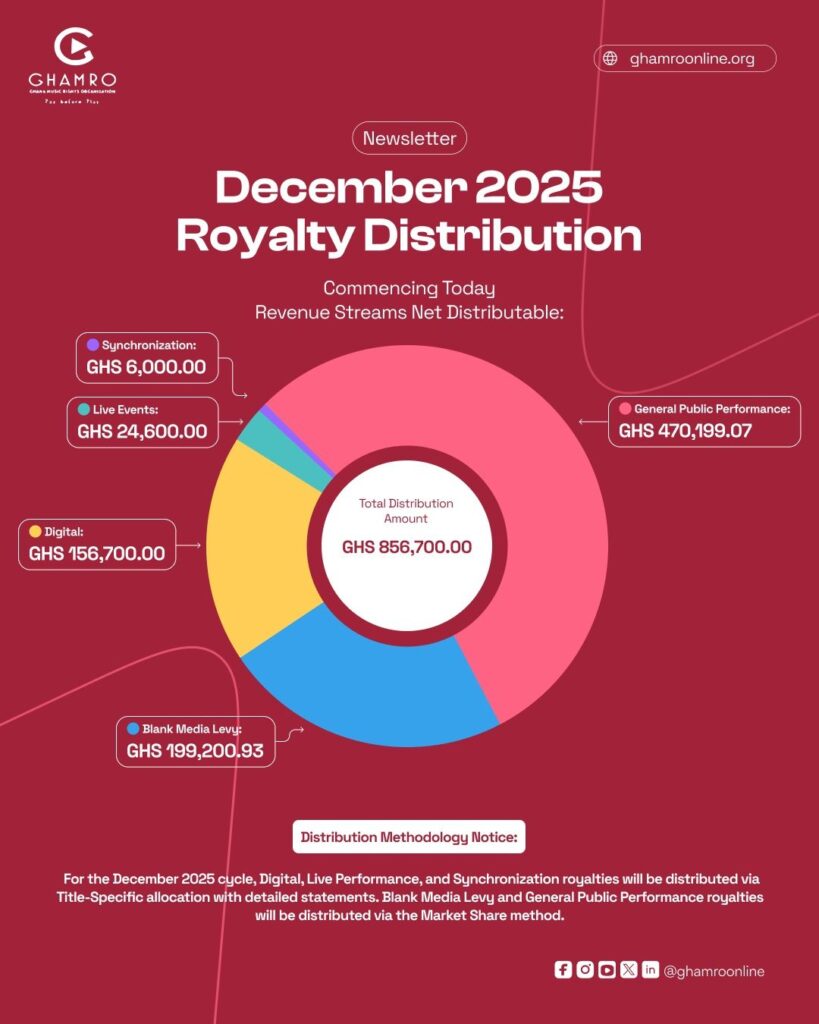
The Ghana Music Rights Organization (GHAMRO), a collective management organization (CMO) in Ghana has announced the distribution of GHS 856,700.00 (approx. $58,000) in royalties for December 2025, marking a significant step in its push for greater transparency and efficiency in the nation’s creative sector.
The distribution covers key revenue streams including Digital, Public Performance, and Blank Media Levy royalties.
In a move framed as a “game-changer” for rightsholders, the CMO simultaneously revealed a new strategic partnership with the World Intellectual Property Organization (WIPO) to integrate the WIPO-Connect platform into its distribution system.
The organization stated that the tech-integrated system will ensure “seamless and accurate distributions,” and provide rightsholders with detailed, real-time royalty statements, a level of reporting transparency that has historically been limited in many African markets.
The system is designed to align with global best practices and is guided by CISAC (International Confederation of Societies of Authors and Composers) rules.
For this distribution cycle, the CMO is applying a hybrid methodology: using title-specific allocation for Digital, Live, and Sync royalties, while applying the market share method for Blank Media Levy and General Public Performance royalties.
This approach aims to balance precision with operational scale. Despite the progress, the GHAMRO issued a pointed reminder that systemic challenges remain, stating that the system’s “full potential can only be realized when over 90% of Broadcast Networks (Non-compliant users) in Ghana commit to paying royalties.”
The statement highlights the ongoing issue of widespread non-compliance from domestic broadcasters, which continues to cap the revenue potential for Ghanaian creators even as distribution mechanisms modernize.
The move positions GHAMRO as one of the first CMOs in West Africa to formally integrate WIPO’s digital infrastructure, signaling a broader shift toward tech-driven transparency in Africa’s royalty ecosystem.