











Insights Digest provides in-depth, data-driven insights into Africa’s music industry through reports, analytics, and market data.
- IFPI Global Music Report 2025 – View Report here
- Luminate 2025 Year-End Music Report – View Report here
- Chartmetric’s 2025 Year in Music Industry Report – View Report here
Global recorded music revenues grew for a tenth consecutive year in 2024, reaching $29.6 billion, a 4.8% year-on-year increase, according to the IFPI’s Global Music Report 2025.
The growth was broad-based, with 55 of the 58 markets tracked by IFPI showing positive results. Streaming remained the primary driver, with revenues exceeding $20 billion for the first time.
At $20.4 billion, the streaming segment accounted for 68.9% of total global income. Subscription audio streaming revenues grew by 9.5%, while ad-supported formats grew by a more modest 1.2%.
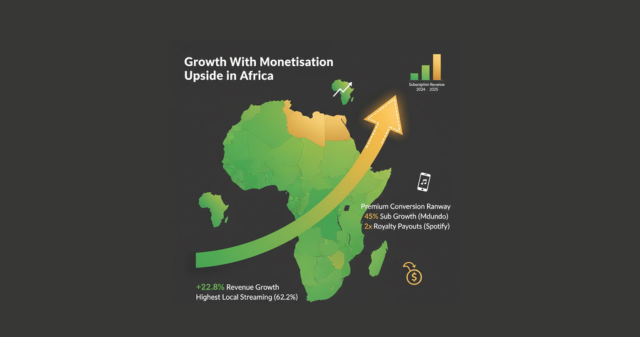
A significant portion of this growth originated from emerging regions. The Middle East and North Africa (MENA) was the fastest-growing region globally, with revenues increasing by 22.8% in 2024.
Sub-Saharan Africa followed closely with 22.6% growth, reinforcing the region’s position as a key engine of global expansion.
Monetization in high-growth African markets accelerated in 2025. According to its year-end financial results, the African streaming service Mdundo reported a 45% year-on-year increase in subscription revenue for the six months ending December 2024, signaling strong progress in converting users to paid tiers.
Audiomack, in a January 2025 press release, announced it had surpassed 50 million monthly active users, marking 31% growth from the previous year and underscoring the massive, engaged audience for music streaming on the continent.
Royalty payments to African creators saw substantial increases. Spotify’s 2025 “Loud & Clear” report, published in March 2025, revealed that payments to Nigerian artists more than doubled in 2024 to over ₦58 billion (approximately $38 million).
Payments to South African rightsholders grew 54% to around 400 million Rand ($21 million). The number of Nigerian artists earning over ₦10 million annually from Spotify has tripled since 2022.
Global consumption metrics reinforce the central role of streaming. Data from Luminate’s 2025 Year-End Music Report shows Global On-Demand Audio streams grew by 9.6% year-on-year. However, this consumption is highly concentrated.
Tracks generating between 1 million and 50 million global audio streams made up 49.4% of all streaming volume. In contrast, 88% of all tracks had 1,000 streams or less.
The competitive landscape for artists continues to intensify. Chartmetric’s 2025 Year in Music Industry Report indicates a significant expansion of the available catalog, with the platform now tracking 11.3 million artists – an increase of 1.7 million from the previous year. The number of indexed tracks grew to 25.7 million, nearly 30% more than in 2023.
Within this expanding and competitive global market, specific regions demonstrate unique consumption patterns. Nigeria is the most locally driven market in the Middle East and Africa region, with 62.2% of its Total On-Demand (Audio + Video) streams originating from local artists, according to Luminate.
Concurrently, Nigeria improved its position in Luminate’s Global Export Power Rankings, rising to 19th in 2025 from 23rd in 2024. This dual strength in domestic loyalty and growing international reach underscores its pivotal role.
Genre export from Africa gained significant momentum. Spotify’s 2025 data showed that the South African genre amapiano achieved 1.4 billion streams in 2023, representing over 5,600% growth since 2018. Furthermore, Spotify reported that Kenyan artists were discovered by more than 95 million first-time listeners globally in 2024.
The industry faces significant policy challenges related to new technology. The IFPI report identifies key priorities for sustaining growth, including combating evolving forms of piracy and streaming manipulation.
A major focus is on the responsible development of Artificial Intelligence (AI). IFPI advocates for a regulatory framework that mandates authorization for the use of copyrighted music in AI training models and requires developers to maintain transparency about the content used.
Physical formats continue to play a role in a diversified revenue base. While global physical revenues declined by 3.1% in 2024 to $4.8 billion, this followed a strong 14.5% increase in 2023. Within this segment, vinyl revenues grew for an 18th consecutive year, rising by 4.6%.
The data from 2025 reports and financial disclosures paints a picture of an industry in a phase of layered growth: achieving global revenue records driven by streaming, while witnessing accelerated monetization and creator earnings in high-growth African markets, navigating intense competition, and addressing the foundational challenges posed by new technologies.